Ulcerative Colitis (UC)
What is ulcerative colitis?
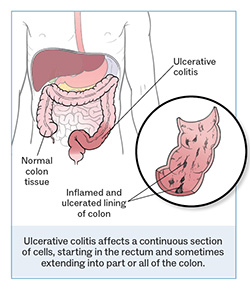
Ulcerative [UHL-ser-uh-tiv] colitis [koh-LIE-tis] (UC) is a long-term (chronic) disease of the colon (large intestine). The colon is where fluids are re-absorbed and waste products are prepared for elimination (pooping). UC causes inflammation (swelling) and ulcers (sores) in the lining of the rectum and colon, usually in a continuous section of the colon, beginning at the rectum.
What causes UC?
UC is an autoimmune condition where your immune system mistakenly attacks your own tissues. Doctors aren’t sure what causes UC, but most agree that it is NOT caused by sensitivity to certain foods or by stress. However, these factors may trigger symptoms in someone who already has the disease.
We do know that patients with UC have abnormal immune system reactions that kill healthy cells in the lining of the colon. Inflammation and ulcers then form around the dead cells.
While it is not clear what causes this abnormal reaction, you may be more at risk based on your:
-
Family history. You’re more likely to have UC if a close family member has it.
-
Ethnicity. You’re more likely to develop this disease if you are of Eastern European (Ashkenazi) Jewish descent.
-
Age. UC can start at any age, but usually starts between ages 15 and 30. Less often, it can begin between ages 50 and 70.
-
Environment. UC is more common among people who live in urban areas and industrialized countries.
What are the symptoms of UC?
Common symptoms include:
-
Abdominal (belly) pain
-
Diarrhea (may contain blood)
-
Frequent or urgent bowel movements (poops)
-
Fatigue
-
Fever — especially during flares
-
A sensation of needing to have a bowel movement while sleeping
-
Rectal bleeding
-
Weight loss
Other symptoms include:
Symptoms can come and go and sometimes disappear for months, or even years, at a time.
How is UC diagnosed?
-
A colonoscopy is the best way to tell if you have UC. During a colonoscopy, a thin, flexible tube with a camera at the end is used to look inside your colon. There, the doctor can see inflammation or bleeding, and can take tissue samples (biopsies) to analyze in a laboratory.
-
Imaging, such as MR enterography or CT enterography to look for cell changes in the colon and rectum.
-
Blood tests are used to look for signs of anemia (low red blood cells) or infection in the rectum or colon.
-
A stool (poop) sample can also show signs of bleeding or infection in the colon or rectum.
How is UC treated?
What can I do?
How can I find support for my physical and mental health?
-
IBD Support Foundation (ibdsf.org)
-
Crohn’s and Colitis Foundation (crohnsandcolitisfoundation.org)
-
Counseling or therapy
-
Support groups
-
Stress-reduction methods, such as yoga, exercise, and mindfulness practice. (Please talk with your primary care team before starting an exercise plan.)
When should I call my healthcare provider?
Call your healthcare provider if you have:
-
Abdominal pain or blood in your stool
-
Ongoing diarrhea that does not get better with over-the-counter medicine
-
Unexplained fever of 101° F (38° C) or higher that lasts more than a few days
© 2008–2026 Intermountain Health. All rights reserved. The content presented here is for your information only. It is not a substitute for professional medical advice, and it should not be used to diagnose or treat a health problem or disease. Please consult your healthcare provider if you have any questions or concerns. FS006 - 05/26 (Last reviewed - 05/26) Also available in Spanish.